A parent brings back unfinished work and says, “We just couldn’t get to it this week.” As the Instructor, you need to understand what happened before deciding what comes next. Was there no workable study time? Were the materials hard to find? Or did the student start promptly and get stuck?
Kumon provides a parent guide to home study covering the study approach. The conversation and planning template below are independent suggestions for putting a family’s circumstances into focus. Use them alongside your current Kumon guidance and the student’s individual plan.
Ask about the last attempt, not the ideal week
“What time do you usually study?” may produce the answer the family hopes is true. Try: “Walk me through the last day you tried. What happened before you got the materials out, and what happened next?” Include the student in an age-appropriate way.
Listen for the point where the routine stopped. A folder left in another caregiver’s car calls for a materials plan. Starting after a tiring evening activity calls for a scheduling conversation. Repeated difficulty on a particular task calls for your instructional review. More reminders do not address all three problems.
You might open with: “I’d like to make the plan easier to follow. Can we look at one recent afternoon together? I want to understand whether the difficult part was getting started, finding the work, or doing the work.” Keep the conversation private and factual.
Choose a realistic starting cue with the family
Ask the family to identify an event they can recognize on ordinary days: after the afternoon snack, after breakfast, or before leaving for an activity. Then check the awkward days rather than assuming every weekday looks the same. Who is home? Where are the materials? Does that window actually exist?
For a fictional family, “after snack at the kitchen table” might work on Monday, Wednesday, and Friday. On the other days, a different caregiver handles the afternoon. Write down a feasible arrangement for those days too. This is an example to discuss, not a recommendation that every child study at the same time.
Keep the start cue separate from the amount or difficulty of assigned work. Changes to the learning plan belong with you as the Instructor. A family should know how to contact you when the current plan is not working instead of quietly skipping work or adding a large catch-up session.
Make the first step easy to understand
Ask the student to show you how they find the day’s assigned work. Check that the family understands your instructions for materials, recording work, corrections, and returning or submitting it. Use the process appropriate to that student’s study format rather than assuming all families work on paper.
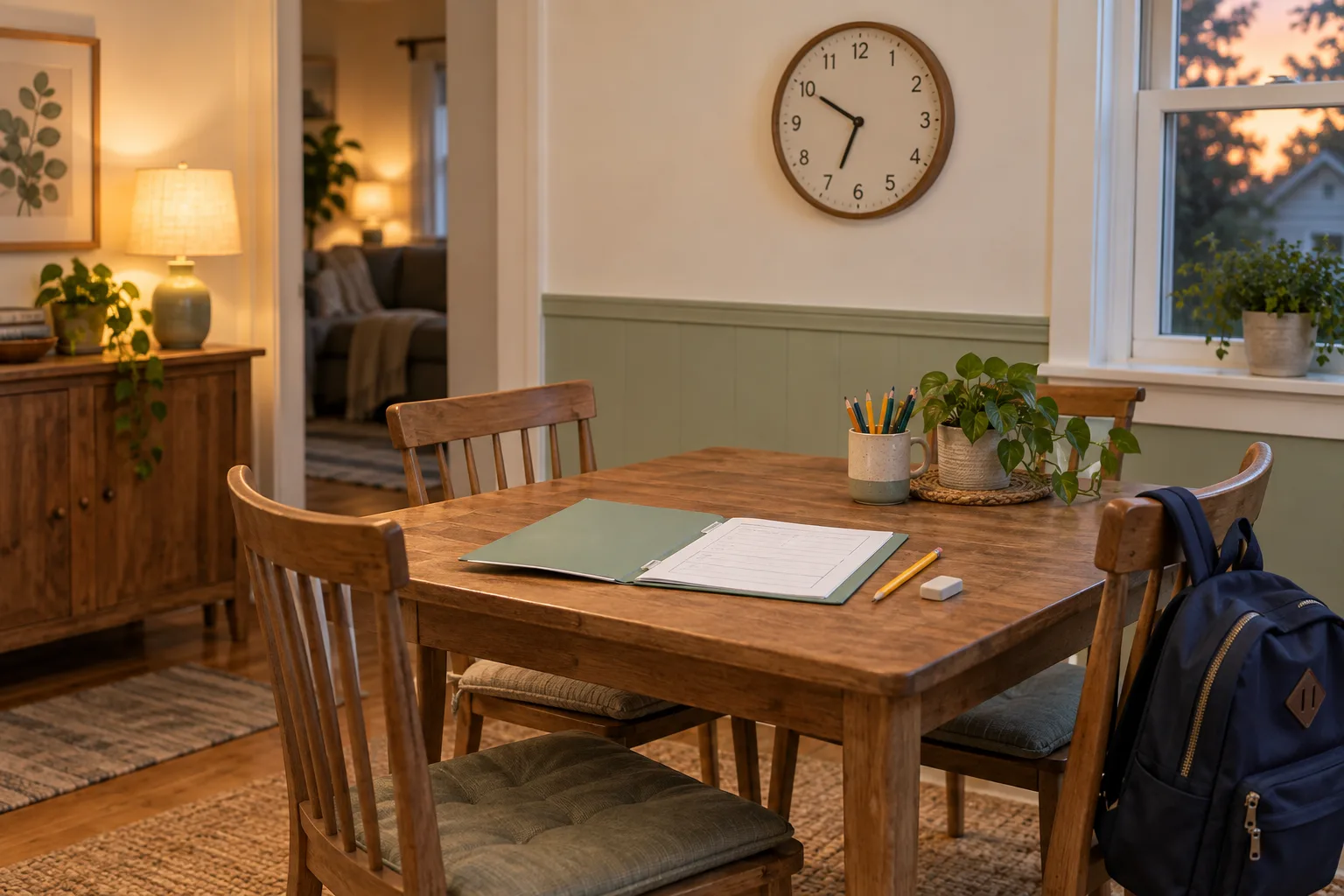
A shared dining table can be a workable place to start. The useful question is whether the student can access the materials and begin without a search or a fresh set of instructions every day. If materials move between homes or caregivers, agree on who makes sure they arrive at the next study location.
Ask the parent to describe their role back to you. Clear expectations about setup and communication are more useful than the vague instruction to “help more.” Explain how they should report a difficulty without taking over the student’s work.
Separate difficulty starting from difficulty studying
A student who avoids opening the folder and a student who opens it willingly but cannot proceed may need different support. Ask what the student attempted, where they paused, and what help was given. Review the actual work and your own observations before drawing a conclusion.
Do not use the number of completed pages alone to judge the routine. A finished set does not tell you how much adult help was involved. Equally, an incomplete set does not tell you whether the student made a sustained attempt.
Agree on what the family should do when a problem recurs and which private channel to use. Give a realistic response window. If distress or repeated difficulty is part of the report, arrange a review rather than simply asking the family to enforce the same routine harder. Our parent conversation guide can help structure that fuller discussion.
Send home a small plan you can review together
Choose one change to try before the next agreed review. For example, move materials to a predictable location before changing the starting time as well. A short trial makes it easier to tell the family which part you are trying to improve.
One-week home-study plan
- Starting cue: After [specific event], at [place].
- Different days: On [days], the arrangement is [agreed alternative].
- Materials: [Person] will make sure [materials or device] are available.
- Student’s first action: [How to locate and begin the assigned work].
- If it becomes difficult: Follow [Instructor’s guidance] and contact [channel].
- One thing to notice: [Starting difficulty, interruptions, or another specific observation].
- Review: We will talk on [date] about what happened.
This is a suggested communication template, not an official Kumon form or a new worksheet requirement. Keep it brief enough that the family can explain it without looking at the page. Store the current agreement in your existing instructional or family-communication system.
Follow up on what happened, not just whether work came back
At the review, ask which parts happened as planned and which did not. “We found the folder every day, but Tuesday’s start time didn’t work” is useful information. Keep the part that helped and revise the part that did not.
Note whether the student could start, whether recurring difficulty was reported, and whether your promised follow-up happened. These are checks on the plan, not a score for the parent or evidence that one week of changes improved learning outcomes. Use your normal instructional review to decide whether assigned work needs adjustment.
When school activities or caregiver arrangements change, revisit the agreement. Our closure planning guide can help you communicate changes to center visits separately from home-study expectations.
Give the conversation room in your center day
A home-study problem deserves more attention than a hurried exchange across the entrance. Set a short appointment or callback and make sure someone owns it. For ideas on protecting that time, see our guide to the busiest hour at a Kumon center.
Keep attendance and home study distinct. Center attendance history can help you establish which visits happened. It cannot tell you whether a student practiced at home, how they approached the work, or what support they received. Ask the family and review the student’s work for that context.
Keep center attendance organized
Classroom Check-In helps Kumon centers manage arrivals, departures, and attendance history. Keep home-study plans and instructional records in the systems you already use.