How to fill quiet tutoring hours without blanket discounts
A packed Tuesday and an empty Thursday can exist in the same center. Find the hours you can actually fill, test a specific offer, and check whether the extra activity adds income after its costs.
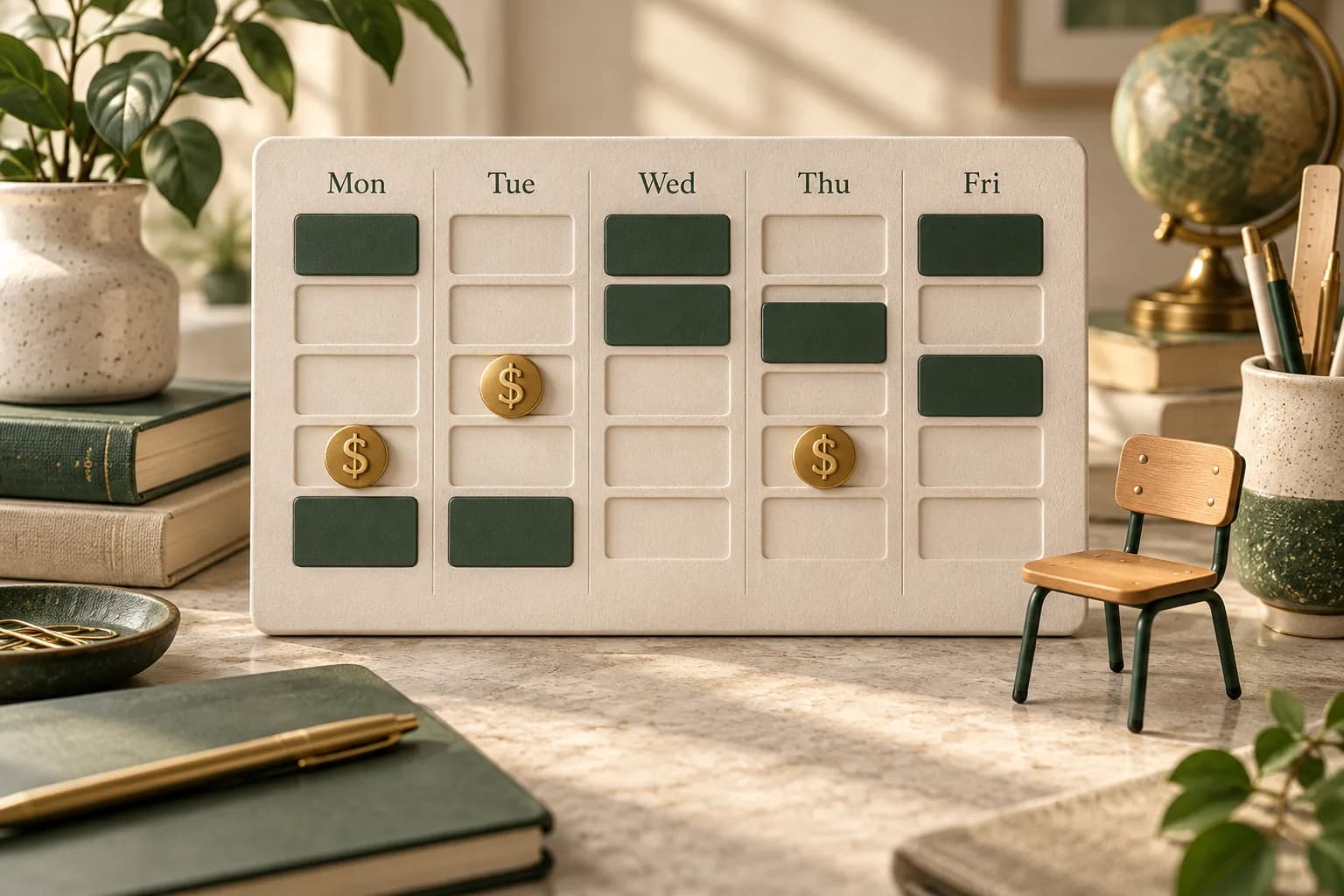
Before spending more on advertising or adding another class, look at the teaching time you already have. A quiet session may be an opportunity, but an empty chair alone does not tell you whether a student can be served well or whether filling it will help the business. Start with one recurring time slot and a small, measurable experiment.
1. Separate available seats from usable capacity
Review a few representative weeks of your timetable, instructor coverage, bookings, and actual visits. Leave holiday weeks or unusual closures out of your baseline, or label them separately. List capacity by session rather than averaging the whole week.
For each slot, ask which subjects and levels the instructor can support, how much individual attention students need, and whether the room and arrival process can handle another student. Use the lower of your staffing and space limits. A spare desk beside an instructor who is already stretched is not a sellable place.
Keep bookings and attendance in separate columns. A booked student who misses a visit may still hold a recurring place. Do not sell that place again without an agreed scheduling arrangement. Digital student check-in can help you review actual arrivals and departures; your scheduling system remains the source for future commitments.
2. Choose one slot and one family need
Pick a time you can offer consistently, then identify who could realistically use it. Ask current families and recent inquiries about school dismissal, transport, sibling schedules, and preferred subjects. Avoid assuming that a quiet afternoon is convenient just because it is convenient for your staff.
A fictional center might have two suitable places on Thursdays at 4:30 for its existing elementary reading program. A clear offer would name the day, time, program, and next step. “Two Thursday reading places available; contact us to discuss fit” gives families more to act on than “We have openings.” Only use a scarcity claim when it is accurate.
Test convenience before discounting: clearer availability, an easier inquiry process, or a recurring appointment that works alongside a sibling’s visit. Keep the learning fit central. Do not combine incompatible levels or sell extra sessions a student does not need just to fill the timetable.
3. Work out what an additional visit contributes
The U.S. Small Business Administration’s break-even guide separates fixed costs from variable costs and uses price minus variable cost to calculate contribution per unit. For a small scheduling experiment, also identify any new costs triggered by opening or extending the session.
Here is an illustrative weekly calculation, not a suggested price or a forecast. Suppose three genuinely additional paid visits bring in $40 each. Materials and payment costs are $5 per visit, and the session requires $60 of additional staff cost including preparation. The experiment leaves $45 before existing overhead and taxes: $120 minus $15 minus $60.
With those assumptions, two visits leave $10 and one loses $25 before existing overhead. If all three visits receive a $10 discount, the three-visit result falls to $15. The point is to use your own numbers before making an offer. Include extra administration, setup, cleanup, and staffing thresholds rather than treating every empty hour as free.
If families pay monthly tuition, filling an unused included visit may add no revenue. Use the actual change in collected fees and delivery costs. Moving an existing student from Tuesday to Thursday also adds no tuition by itself; it helps revenue only if the newly available Tuesday place is subsequently sold, or if the move changes costs in a useful way.
4. Give the experiment a clear scope
Write down the session, suitable student profile, available places, ordinary price, start date, and review date. Assign one person to answer inquiries and maintain the availability list. A four-week trial is one possible operating window, not a universal benchmark; choose a period that gives your program a fair chance to settle.
Share the specific opening through channels you already use appropriately: your website, an opted-in family newsletter, or a relevant response to someone who asked about availability. Our guide to attracting more students covers the broader discovery and inquiry process.
If you do test a special price, define its duration and the subsequent price clearly before enrollment. Keep any existing franchise or program requirements in view. Track the offer separately so you can tell whether it creates additional enrollment or simply lowers the price for families who would have joined anyway.
5. Measure additions, moves, and costs separately
- Inquiries: How many families asked specifically about this time?
- New paid enrollment: How many enrolled students are additional to your existing roster?
- Schedule moves: How many existing students transferred from another session, and were those vacated places filled?
- Delivery: What were actual visits, extra staff hours, preparation time, and other added costs?
- Learning fit: Could instructors provide the planned support without rushing or displacing other students?
Compare the added collected revenue with added costs over the same period. Label pending payments, refunds, and one-time setup costs so they do not disappear inside an average. A fuller room is useful evidence about demand, but it is not proof of higher profit.
6. Keep, adjust, or close the experiment
At the review date, choose a concrete next action. Keep a session that fits students and produces a worthwhile contribution. Adjust the time or audience when inquiries reveal a specific obstacle. If interest remains low, consider consolidating the slot while honoring existing family and staffing commitments.
Protect the time needed to do this work. Repeatedly reconstructing attendance or chasing scattered student records competes with following up on inquiries. Our paper-to-digital check-in guide provides a way to simplify that routine. Use the time saved for a weekly review of actual openings and the families who might be a good fit.
Spend less time reconstructing attendance.
Classroom Check-In keeps arrivals, departures, and attendance history together for tutoring centers. Pair those visit records with your scheduling and financial records when reviewing capacity.